
Compare Type 1, Type 2 and Type 3 surge protective devices by installation position, test waveform, current rating and protection role.
Table of Contents
Find the Information You Need
Type 1, Type 2 and Type 3 SPD Quick Comparison
The easiest way to understand the three SPD types is to connect each type with its normal position in the electrical installation.
| SPD type | Typical position | Main protection role | Principal test duty | Common key rating |
|---|---|---|---|---|
| Type 1 | Origin or main incoming board | Discharges high-energy partial lightning current | 10/350 μs impulse current | Iimp |
| Type 2 | Main or sub-distribution board | Limits induced lightning and switching surges | 8/20 μs discharge current | In and Imax |
| Type 3 | Close to sensitive terminal equipment | Limits remaining residual overvoltage | Combination-wave test | Uoc and Up |
What Is a Type 1 Surge Protective Device?
A Type 1 SPD is designed for installation where partial lightning current may enter the low-voltage electrical system.
It is commonly considered at the origin of an installation, particularly where the building has an external lightning protection system or where the incoming supply arrangement creates significant lightning-current exposure.
What does a Type 1 SPD do?
A Type 1 SPD diverts high-energy impulse current toward the equipotential bonding and earthing system. Its main role is to prevent lightning current from passing uncontrolled through the internal electrical installation.
Type 1 test waveform
Type 1 SPDs are tested using a 10/350 μs current impulse. The main rating associated with this test is Iimp, or impulse discharge current.
Iimp should not be compared directly with the Imax value of a Type 2 SPD because the two ratings use different waveforms and represent different test duties.
Where is a Type 1 SPD installed?
- Service entrance;
- Main low-voltage switchboard;
- Origin of the electrical installation;
- Lightning protection zone transition where partial lightning current is expected.
When should Type 1 be considered?
- The building has an external lightning protection system;
- The incoming supply is exposed to lightning-current entry;
- A project risk assessment identifies partial lightning current;
- National installation rules specify Type 1 protection;
- The installation is critical infrastructure with a defined lightning protection concept.
What Is a Type 2 Surge Protective Device?
A Type 2 SPD is the most common distribution-level surge protective device in low-voltage electrical installations.
It limits transient overvoltages caused by indirect lightning effects, switching operations and residual surge energy from an upstream protection stage.
What surge sources does Type 2 address?
- Indirect lightning effects;
- Switching operations;
- Motors and transformers;
- Utility-network disturbances;
- Residual surge energy after an upstream SPD.
Type 2 test waveform
Type 2 SPDs are tested using the 8/20 μs current waveform. Important ratings include In, Imax, Up and Uc.
Where is a Type 2 SPD installed?
- Main distribution boards;
- Sub-distribution boards;
- Machine-control cabinets;
- Industrial panels;
- Commercial electrical panels;
- Solar inverter AC distribution panels.
When may Type 2 be sufficient?
A Type 2 SPD may be sufficient at the origin of some installations where the system is not expected to carry partial lightning current.
This may include certain installations with:
- Underground incoming supply;
- No external lightning protection system;
- Lower assessed lightning-current exposure;
- No upstream Type 1 duty requirement.
What Is a Type 3 Surge Protective Device?
A Type 3 SPD provides point-of-use protection for sensitive terminal equipment. It limits residual surge voltage remaining after upstream protection or developing along downstream conductors.
Where is Type 3 installed?
Type 3 is installed close to protected equipment, including:
- PLCs;
- Servers;
- Control systems;
- Communication equipment;
- Medical equipment;
- Sensitive power supplies;
- Electronic household equipment.
Type 3 protection may be built into socket outlets, power strips, equipment-protection modules, control-panel devices or terminal-protection units.
Type 3 test method
Type 3 devices are commonly evaluated with a combination-wave generator producing a 1.2/50 μs open-circuit voltage waveform and an 8/20 μs short-circuit current waveform. Relevant ratings may include Uoc and Up.
Can Type 3 be used alone?
Type 3 should not normally be expected to discharge the high surge energy present at the service entrance or main distribution level.
Technical Comparison: Type 1 vs Type 2 vs Type 3
| Comparison item | Type 1 SPD | Type 2 SPD | Type 3 SPD |
|---|---|---|---|
| Main role | Lightning-current discharge | Distribution-level surge limitation | Final equipment protection |
| Typical position | Origin or main incoming board | Main or sub-distribution board | Close to terminal equipment |
| Test class | Class I | Class II | Class III |
| Principal waveform | 10/350 μs | 8/20 μs | Combination wave |
| Important rating | Iimp | In and Imax | Uoc |
| Also evaluate | Uc, Up and fault behaviour | Uc, Up and short-circuit rating | Up and load compatibility |
| Typical surge environment | Partial lightning current | Induced lightning and switching transients | Residual surge voltage |
| Can it protect the whole installation alone? | Not necessarily | Not necessarily | No |
| Common technology | Spark gap, MOV or combined technology | MOV-based or combined technology | Compact MOV, GDT or filter-based protection |
10/350 μs vs 8/20 μs: Why the Test Waveform Matters
A current value shown in kiloamperes is meaningful only when the associated waveform and rating definition are also known.
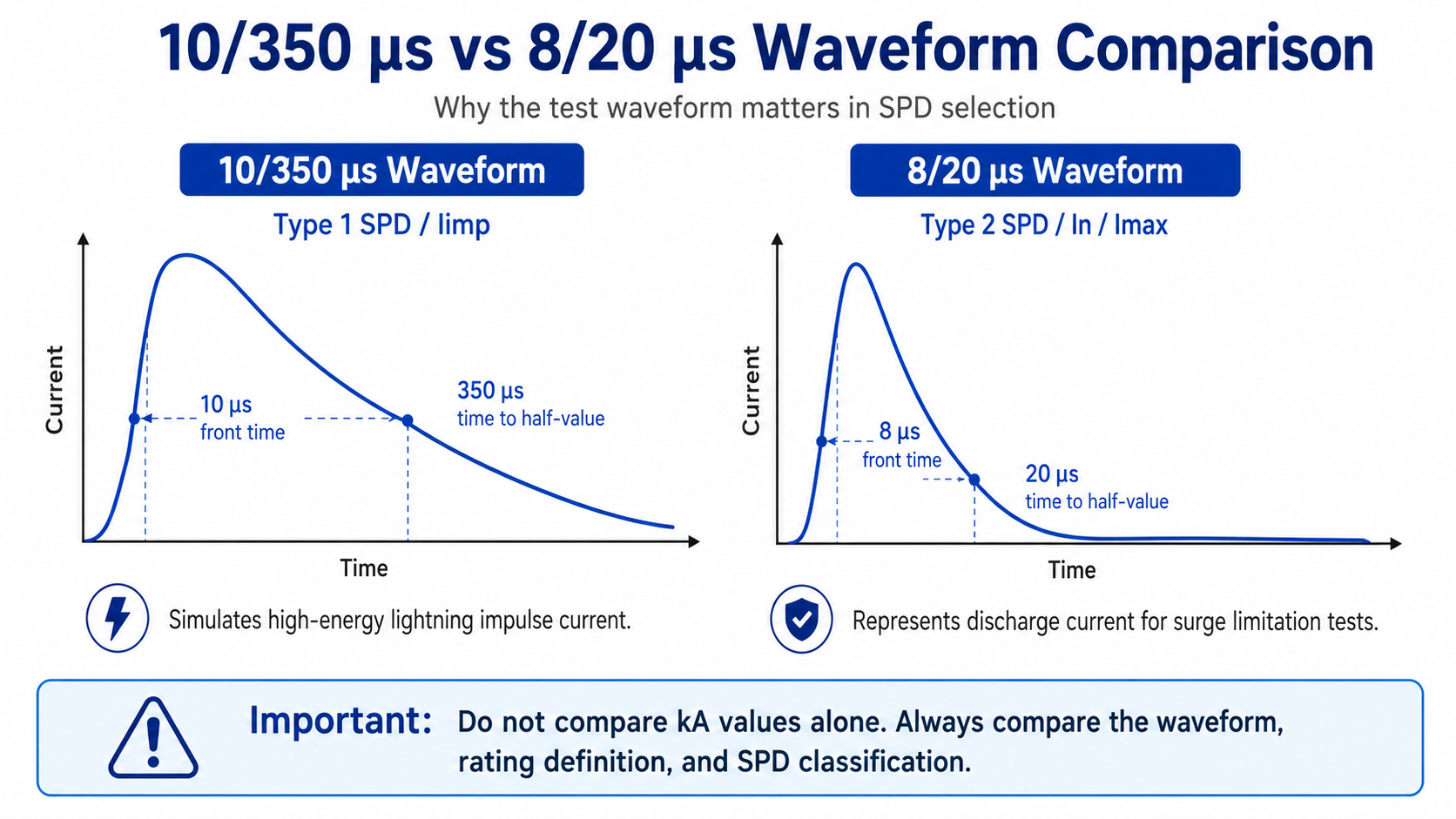
Iimp vs In vs Imax vs Uoc
These values describe different tests and should not be treated as interchangeable versions of the same current rating.
Other important values include Uc, Up, short-circuit current rating and backup protection requirements.
How Type 1, Type 2 and Type 3 SPDs Work Together
Effective surge protection is based on coordinated protection stages, not simply on installing the SPD with the largest current rating.
A typical concept may use:
- Type 1 at the origin to discharge partial lightning current;
- Type 2 in a downstream distribution board to limit remaining overvoltage;
- Type 3 near sensitive equipment to reduce final residual surge voltage.
This does not mean every building must use three separate SPDs. Possible alternatives include Type 1+2 combined SPDs, Type 2+3 combined SPDs, or Type 2 protection at the origin where Type 1 duty is not required.
No single cable-distance rule should be applied to every SPD combination. Required coordination depends on SPD technology, manufacturer-tested coordination, conductor arrangement, protection levels and the protected equipment.
What Is a Type 1+2 Combined SPD?
A Type 1+2 SPD is tested for both Type 1/Class I and Type 2/Class II duties. It combines lightning impulse-current discharge and distribution-level surge-voltage limitation.
A Type 1+2 SPD may be useful where:
- Both protection duties are required at one installation point;
- Main-board space is limited;
- Separate SPD coordination would be difficult;
- A compact internally coordinated solution is preferred.
For complete Type 1+2 selection guidance, see the dedicated Type 1+2 SPD guide.
Which SPD Type Do You Need?
The following table provides an initial direction. Final selection must still follow the actual system design and applicable requirements.
| Project situation | Initial selection direction |
|---|---|
| Building has an external lightning protection system | Consider Type 1 or Type 1+2 |
| Partial lightning current may enter the installation | Type 1 duty is required |
| General main-panel protection without Type 1 duty | Type 2 |
| Sub-distribution or machine-control panel | Type 2 |
| Sensitive terminal equipment | Type 3 near the equipment |
| Type 1 and Type 2 duties are required in one main board | Type 1+2 |
| Equipment is far from the main SPD | Consider additional Type 2 or Type 3 |
| Surge protection is required on a solar PV DC circuit | Use a PV-specific DC SPD |
How to Select the Correct SPD Type
- Identify the installation position. Is the SPD installed at the origin, distribution board, machine panel or terminal equipment?
- Assess lightning exposure. Check the external lightning protection system, incoming supply and lightning protection zones.
- Confirm AC or DC application. Do not use a normal AC SPD on the DC side of a photovoltaic system.
- Confirm the earthing system. Identify TN-S, TN-C, TT, IT or the relevant DC grounding arrangement.
- Check the full rating set. Review Uc, Up, Iimp, In, Imax, Uoc, short-circuit rating and backup protection.
- Verify coordination. Check the relationship between upstream protection, downstream SPDs and protected equipment.
Common SPD Selection Mistakes
- Choosing only by the largest kA value. A larger current number does not correct the wrong waveform, voltage rating or circuit configuration.
- Comparing Iimp directly with Imax. These values represent different test duties and different waveforms.
- Using Type 3 as the main building SPD. Type 3 is intended for final equipment protection, not high-energy incoming surge current.
- Assuming Type 1 protects every load. Residual voltage and downstream conductor effects may still require additional protection.
- Using a fixed 10-meter rule. Coordination must follow the selected SPD technologies and manufacturer documentation.
- Ignoring Uc and Up. Current capacity alone does not determine voltage compatibility or equipment protection.
- Using an AC SPD on PV DC. Photovoltaic DC circuits require application-specific voltage and disconnection characteristics.
- Ignoring short-circuit coordination. The SPD, backup fuse and prospective short-circuit current must be compatible.
IEC and UL SPD Types Are Not Identical Definitions
IEC and UL systems both use Type 1, Type 2 and Type 3 terminology, but the classifications should not be treated as fully interchangeable.
Under the IEC framework, the types are closely associated with test classes, waveforms and protection duties. Under UL 1449, SPD types are strongly related to the permitted connection location and installation relative to service equipment and overcurrent protection.
For North American projects, confirm:
- UL listing;
- SPD type;
- Nominal discharge current;
- Voltage protection rating;
- Short-circuit current rating;
- Permitted connection location.
Type 1 vs Type 2 vs Type 3 SPD FAQ
What is the main difference between Type 1, Type 2 and Type 3 SPD?
Type 1 manages lightning-current duty at the origin, Type 2 provides distribution-level surge protection, and Type 3 limits residual surge voltage close to sensitive equipment.
Is Type 1 better than Type 2?
No. They perform different roles. Type 1 handles lightning-current duty, while Type 2 limits transient overvoltage in the electrical distribution system.
Can Type 2 be installed at the main distribution board?
Yes. Type 2 is commonly installed in main and sub-distribution boards where Type 1 lightning-current duty is not required or where an upstream Type 1 stage already exists.
Does every installation need a Type 1 SPD?
No. The need for Type 1 depends on lightning-current exposure, external lightning protection, the incoming supply arrangement and applicable project requirements.
Can Type 3 SPD be used without Type 1 or Type 2?
Type 3 should not normally be relied upon as the only protection where high-energy surges may enter the installation. It is intended primarily as coordinated terminal protection.
Is Type 1+2 the same as Type 1 and Type 2?
A Type 1+2 SPD is tested for both Type 1 and Type 2 duties within one product. Separate Type 1 and Type 2 devices can provide the same stages, but their coordination must be verified.
What is the difference between Iimp and Imax?
Iimp is associated with the 10/350 μs Type 1 impulse-current test. Imax is associated with the 8/20 μs Type 2 maximum discharge-current test.
Can LEEYEE help select the correct SPD type?
Yes. Provide the system voltage, AC or DC application, earthing arrangement, installation position, poles, required ratings and project quantity.
Related Surge Protection Guides
Need Help Selecting the Correct SPD Type?
Send the AC or DC application, system voltage, earthing arrangement, installation position, required poles, current ratings and project quantity. LEEYEE will help identify a suitable surge protection configuration.